Halo, saya Hello, I am

Adi Rizky Pratama

Saya seorang I am a

Dosen Teknik Informatika di UBP Karawang sekaligus Programmer Freelance. Menggabungkan riset akademis di bidang AI & Machine Learning dengan pengembangan solusi teknologi nyata untuk industri. Lecturer of Informatics Engineering at UBP Karawang and a Freelance Programmer. Combining academic research in AI & Machine Learning with the development of real-world technology solutions for industry.

6+
Publikasi Publications
50+
Sitasi Citations
10+
Proyek Projects
Dosen & Peneliti Lecturer & Researcher
Full-Stack Dev Full-Stack Dev
AI / ML AI / ML
Geser untuk efek 3D Drag for 3D effect
Adi Rizky Pratama

Akademisi yang Melek Industri Industry-Savvy Academician

Sebagai dosen di Program Studi Teknik Informatika Universitas Buana Perjuangan Karawang, saya mengajar dan meneliti di bidang kecerdasan buatan, pengolahan citra, dan pengembangan aplikasi. Di sisi lain, pengalaman sebagai programmer freelance memungkinkan saya menjembatani teori dan praktik — menghadirkan solusi teknologi yang didasari riset ilmiah yang kuat. As a lecturer in the Informatics Engineering Study Program at Universitas Buana Perjuangan Karawang, I teach and conduct research in artificial intelligence, image processing, and application development. On the other hand, my experience as a freelance programmer allows me to bridge theory and practice — delivering technology solutions built on robust scientific research.

Menjabat sebagai Kepala Pusat Data dan Informasi (PUSDATIN) UBP Karawang, saya terbiasa memimpin proyek digitalisasi skala besar dan berkolaborasi lintas tim. Serving as the Head of the Center for Data and Information (PUSDATIN) at UBP Karawang, I am accustomed to leading large-scale digitalization projects and collaborating across teams.

Dosen Tetap Full-time Lecturer

Teknik Informatika, UBP Karawang Informatics Engineering, UBP Karawang

Riset AI & ML AI & ML Research

CNN, LSTM, k-NN, OCR

Kepala PUSDATIN Head of PUSDATIN

Digitalisasi & Data Center Digitalization & Data Center

Freelance Dev Freelance Dev

Web & Mobile Applications Web & Mobile Applications

Apa yang Bisa Saya Bantu? How Can I Help You?

Menggabungkan keahlian akademis dan pengalaman industri untuk memberikan solusi terbaik. Combining academic expertise and industry experience to deliver the best solutions.

Software Development

Pengembangan aplikasi web & mobile custom sesuai kebutuhan bisnis Anda. Dari landing page hingga sistem enterprise. Custom web & mobile application development tailored to your business needs. From landing pages to enterprise systems.

IT Consulting

Konsultasi arsitektur sistem, pemilihan teknologi, transformasi digital, dan optimasi infrastruktur IT. Consulting on system architecture, technology stack selection, digital transformation, and IT infrastructure optimization.

Corporate Training

Pelatihan pemrograman, data science, dan AI untuk tim korporat maupun institusi pendidikan. Programming, data science, and AI training for corporate teams and educational institutions.

Research Collaboration

Kolaborasi riset di bidang machine learning, computer vision, dan data mining untuk publikasi ilmiah. Research collaboration in machine learning, computer vision, and data mining for scientific publications.

Tech Stack yang Dikuasai Mastered Tech Stack

HTML5
CSS3
JavaScript
Bootstrap
PHP
Laravel
Node.js
Python
TensorFlow
Keras
MySQL
PostgreSQL
Git & GitHub

Tri Dharma Perguruan Tinggi Three Pillars of Higher Education

Pengajaran, penelitian, dan pengabdian masyarakat sebagai fondasi kontribusi ilmiah. Teaching, research, and community service as the foundation of scientific contribution.

Mata Kuliah yang Diampu Courses Taught

Pemrograman Web Web Programming
Kecerdasan Buatan Artificial Intelligence
Machine Learning Machine Learning
Pengolahan Citra Digital Digital Image Processing
Basis Data Database Systems
Pemrograman Mobile Mobile Programming

Pengabdian Masyarakat Community Service

Digitalisasi UMKM melalui implementasi e-learning, QRIS, dan sistem informasi untuk pelaku usaha mikro di Karawang. Digitalization of MSMEs through the implementation of e-learning, QRIS, and information systems for micro-businesses in Karawang.

Highlight Publikasi Riset Research Publication Highlights

1

Penggunaan media pembelajaran Wordwall untuk meningkatkan minat dan motivasi belajar siswa The use of Wordwall learning media to improve students' interest and learning motivation

Zahro, N. A. Q., & Pratama, A. R.

50+ Sitasi 50+ Citations Jurnal Journal
2

Perbandingan Algoritma Apriori Dan FP-Growth Terhadap Market Basket Analysis Comparison of Apriori and FP-Growth Algorithms for Market Basket Analysis

Fathurrahman, M., Pratama, A. R., & Al-Mudzakir, T.

Data Mining Jurnal Journal
3

Implementasi CNN Untuk Klasifikasi Citra Kemasan Kardus Defect dan No Defect CNN Implementation for Defect and No Defect Cardboard Box Image Classification

Antoni, A., Rohana, T., & Pratama, A. R.

Computer Vision CNN

Proyek & Hasil Karya Projects & Creative Works

Koleksi proyek dari dunia akademik, freelance, dan open source. A collection of projects from academic, freelance, and open-source fields.

Memuat proyek... Loading projects...

Pengalaman & Pendidikan Experience & Education

Perjalanan karir di dunia akademik dan industri teknologi. Career journey in the academic world and technology industry.

Akademik Academic 2018 — Sekarang 2018 — Present

Dosen Tetap Full-time Lecturer

Universitas Buana Perjuangan Karawang

Mengajar mata kuliah Pemrograman Web, AI, Machine Learning, dan membimbing riset mahasiswa di Program Studi Teknik Informatika. Teaching Web Programming, AI, Machine Learning, and supervising student research in the Informatics Engineering Study Program.

Freelance Freelance 2019 — Sekarang 2019 — Present

Freelance Web Programmer Freelance Web Programmer

Berbagai Klien & Proyek Various Clients & Projects

Mengembangkan aplikasi web dan mobile untuk klien dari berbagai industri. Spesialisasi di PHP/Laravel, JavaScript, dan Python. Developing web and mobile applications for clients across various industries. Specializing in PHP/Laravel, JavaScript, and Python.

Akademik Academic 2018 — Sekarang 2018 — Present

Kepala PUSDATIN Head of PUSDATIN

UBP Karawang

Memimpin Pusat Data dan Informasi universitas. Mengelola infrastruktur IT, sistem informasi akademik, dan digitalisasi kampus. Leading the university's Center for Data and Information. Managing IT infrastructure, academic information systems, and campus digitalization.

Pengabdian Service 2021 — Sekarang 2021 — Present

Digitalisasi UMKM MSME Digitalization

Karawang & Sekitarnya Karawang & Surrounding Areas

Program pengabdian masyarakat: pelatihan IT, implementasi e-learning dan QRIS untuk pelaku usaha mikro. Community service program: IT training, e-learning implementation, and QRIS integration for micro-businesses.

Pendidikan Education 2015 — 2017

S2 — Magister Teknik Informatika Master of Informatics Engineering

Universitas / Institusi University / Institution

Fokus studi pada kecerdasan buatan, pengolahan citra, dan machine learning. Study focus on artificial intelligence, image processing, and machine learning.

Pendidikan Education 2011 — 2015

S1 — Sarjana Teknik Informatika Bachelor of Informatics Engineering

Universitas / Institusi University / Institution

Fondasi keilmuan di bidang pemrograman, basis data, jaringan komputer, dan rekayasa perangkat lunak. Foundational knowledge in programming, databases, computer networks, and software engineering.

Hubungi Saya Contact Me

Ada proyek, kolaborasi riset, atau pertanyaan? Jangan ragu untuk menghubungi. Have a project, research collaboration, or question? Feel free to reach out.

Mari Berkolaborasi! Let's Collaborate!

Saya selalu terbuka untuk peluang kolaborasi, baik di bidang akademik maupun pengembangan software. Silakan hubungi saya melalui platform berikut. I am always open to collaboration opportunities, both in the academic sphere and software development. Please contact me through the platforms below.
Advertisement
Responsive Ad Unit (Top Banner)

Rabu, 08 Juli 2026

Recycled RAM in AI Data Centers: Meta's Strategy to Reduce Costs and Emissions

Recycled RAM in AI Data Centers: Meta's Strategy to Reduce Costs and Emissions

Recycled RAM in AI Data Centers: Meta's Strategy to Reduce Costs and Emissions

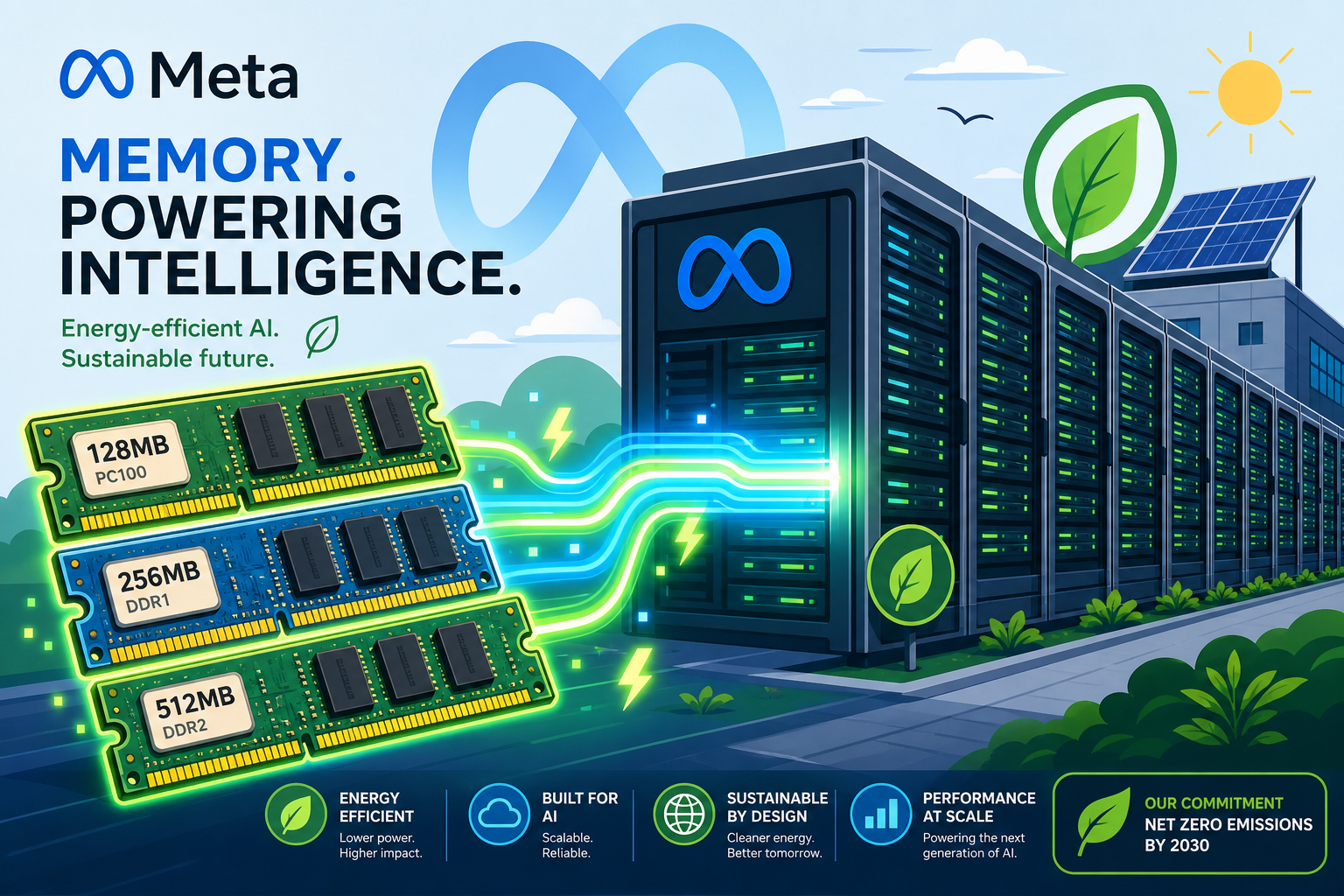
As tech giants race to build the latest GPU clusters to train large language models (LLMs), Meta has taken a seemingly counter-intuitive step: filling its AI servers with used RAM modules. Not due to a lack of funds, but as a result of careful calculation between supply chain constraints, inference workload characteristics, and long-term sustainability ambitions.

Why Meta Adopts Recycled RAM for AI Servers

Supply Constraints and Costs of New Memory Modules

The surge in demand for high-bandwidth memory (HBM) and DDR5 for AI accelerators has created shortages across the industry. Memory manufacturers have shifted production capacity to premium variants, causing used DDR4 and even DDR3 modules to pile up in the secondary market. Meta saw an opportunity: rather than competing for limited supplies at skyrocketing prices, they absorb stock of older-generation modules from decommissioned data centers or trusted recycling vendors. The cost per gigabyte can drop by 60–80% compared to buying new DDR5. At the scale of a cluster with hundreds of thousands of nodes, these upfront savings become significant immediately.

Throughput Potential of Older-Generation Memory for Inference Workloads

AI model inference—especially on large transformer architectures—is often more GPU-compute-bound than CPU memory speed. After the model is loaded into VRAM, communication between host and device occurs in small chunks: compressed weights, batch metadata, or token results flowing back. DDR4-3200 can provide around 25 GB/s per channel, enough to serve inference pipelines that don't require massive weight streaming from system RAM. Even DDR3 at 1866 MT/s is still adequate for container orchestration, small dataset caching, and logging. Throughput discrepancy only becomes apparent when training giant models with optimizer offloading to RAM; that's why Meta does not use recycled RAM for their main training clusters, but for inference farms and development environments.

AI Server Architecture with Used RAM

Memory-Generation-Agnostic Software Design

The key to making used RAM work seamlessly is smart abstraction. Meta has built fleet management and a scheduler that does not depend on the physical characteristics of specific DIMMs. Services such as PyTorch runtime or Triton Inference Server only see memory allocation as byte buffers. With Linux cgroups and memory limits, administrators can set quotas without caring whether DDR3 or DDR5 is underneath. Here is an example of how direct inspection reveals the type of DIMM installed without affecting allocation logic:

sudo dmidecode --type memory | grep -E "Type:|Speed:|Size:"

The output of that command might show Type: DDR4 at various speeds, but the scheduler only cares that total capacity is available as requested. This pattern is similar to the 'cattle, not pets' philosophy: AI servers don't pamper specific memory modules.

Dynamic Allocation for Model Training and Inference

In inference clusters, Meta applies tiering: servers with the latest generation RAM (DDR5) are prioritized for training or fine-tuning that requires intensive swapping between CPU and GPU. Servers with recycled RAM are dedicated to serving mature models, often with dynamic batching. Internal platforms like Triton can move models between nodes based on memory profile. If a model requires more system RAM capacity than available on a recycled node, the scheduler places it on a DDR5 node. This is done transparently through Kubernetes labels describing the memory class:

apiVersion: v1
kind: Node
metadata:
  labels:
    meta.ai/memory-tier: recycled-ddr4

Thus, inference pods simply add the appropriate nodeSelector or affinity.

Impact on Energy Efficiency and Operational Costs

Reduction in Power Consumption per Teraflop of Compute

Used DDR3 and DDR4 modules often operate at lower voltages compared to new, high-speed, overclocked modules. A standard DDR4-3200 DIMM consumes about 3–5 watts, while DDR5-4800 can reach 6–8 watts. When multiplied by 16 slots per server, the difference can be 30–50 watts per node purely from memory. In megawatt-scale AI data centers, every watt means substantial savings in cooling and electricity costs. More importantly, inference servers that are GPU-bound (not CPU-RAM-bound) do not lose teraflop performance due to slower memory. This means energy efficiency per floating-point operation actually improves.

Reassessment of Total Cost of Ownership (TCO) at Cluster Scale

Assuming an inference server contains 8 GPUs and recycled RAM priced at 30% of new, memory components contribute only a small fraction of total hardware cost. However, the real savings come from extending asset lifespans and reducing electronic waste. Meta calculates TCO over 5 years: buying recycled RAM not only reduces initial CAPEX, but also lowers depreciation and environmental compliance costs. A cluster with 10,000 inference nodes can save tens of millions of dollars, funds that are then redirected to open-source model research like Llama.

Sustainability Strategy for Future AI Data Centers

Integrating Recycled Components into Infrastructure Lifecycle

Meta's move is not just a one-off project. They are beginning to design the entire lifecycle of AI servers so that components—including RAM, NICs, and storage—can be reused. Servers that are no longer economical for training are not completely dismantled; memory modules that still pass stress tests are automatically redirected to inference fleets. This process is supported by a circular framework that records the history of each DIMM through serial numbers and test logs. With this approach, the carbon footprint of manufacturing new memory—which accounts for the majority of emissions from data center hardware—can be reduced.

Implications for Large Language Model Scaling and the Open-Source Ecosystem

This practice opens the door for the open-source AI community, which often struggles to access cutting-edge hardware. Models released by Meta, such as Llama, are designed to run under various memory conditions, including environments with minimal RAM. CPU-based inference with libraries like llama.cpp can greatly benefit from the availability of cheap servers from decommissioned data centers. If memory recycling becomes an industry standard, the cost barrier to running local LLMs will collapse. Small research labs or startups can buy or lease ex-Meta servers at low prices, democratizing access to advanced model inference. This virtuous cycle actually strengthens the open-source ecosystem that Meta is building.

Ultimately, recycled RAM is not a symbol of compromise, but a re-engineering of old assumptions about memory hierarchy in the AI era. While the industry races to the peak of specifications, Meta proves that sustainability and cost efficiency can go hand in hand, while still serving the huge wave of global inference demand.

This article was written by artificial intelligence (AI) using the deepseek-v4-pro model via SumoPod AI.

This article was translated by Artificial Intelligence (AI) using deepseek-v4-pro via SumoPod AI.

Tidak ada komentar:

Posting Komentar

Dosen Teknik Informatika di UBP Karawang sekaligus Programmer Freelance. Menggabungkan riset akademis di bidang AI & Machine Learning dengan pengembangan solusi teknologi nyata untuk industri.

Cari Blog Ini

Diberdayakan oleh Blogger.

Arsip Blog