Halo, saya Hello, I am

Adi Rizky Pratama

Saya seorang I am a

Dosen Teknik Informatika di UBP Karawang sekaligus Programmer Freelance. Menggabungkan riset akademis di bidang AI & Machine Learning dengan pengembangan solusi teknologi nyata untuk industri. Lecturer of Informatics Engineering at UBP Karawang and a Freelance Programmer. Combining academic research in AI & Machine Learning with the development of real-world technology solutions for industry.

6+
Publikasi Publications
50+
Sitasi Citations
10+
Proyek Projects
Dosen & Peneliti Lecturer & Researcher
Full-Stack Dev Full-Stack Dev
AI / ML AI / ML
Geser untuk efek 3D Drag for 3D effect
Adi Rizky Pratama

Akademisi yang Melek Industri Industry-Savvy Academician

Sebagai dosen di Program Studi Teknik Informatika Universitas Buana Perjuangan Karawang, saya mengajar dan meneliti di bidang kecerdasan buatan, pengolahan citra, dan pengembangan aplikasi. Di sisi lain, pengalaman sebagai programmer freelance memungkinkan saya menjembatani teori dan praktik — menghadirkan solusi teknologi yang didasari riset ilmiah yang kuat. As a lecturer in the Informatics Engineering Study Program at Universitas Buana Perjuangan Karawang, I teach and conduct research in artificial intelligence, image processing, and application development. On the other hand, my experience as a freelance programmer allows me to bridge theory and practice — delivering technology solutions built on robust scientific research.

Menjabat sebagai Kepala Pusat Data dan Informasi (PUSDATIN) UBP Karawang, saya terbiasa memimpin proyek digitalisasi skala besar dan berkolaborasi lintas tim. Serving as the Head of the Center for Data and Information (PUSDATIN) at UBP Karawang, I am accustomed to leading large-scale digitalization projects and collaborating across teams.

Dosen Tetap Full-time Lecturer

Teknik Informatika, UBP Karawang Informatics Engineering, UBP Karawang

Riset AI & ML AI & ML Research

CNN, LSTM, k-NN, OCR

Kepala PUSDATIN Head of PUSDATIN

Digitalisasi & Data Center Digitalization & Data Center

Freelance Dev Freelance Dev

Web & Mobile Applications Web & Mobile Applications

Apa yang Bisa Saya Bantu? How Can I Help You?

Menggabungkan keahlian akademis dan pengalaman industri untuk memberikan solusi terbaik. Combining academic expertise and industry experience to deliver the best solutions.

Software Development

Pengembangan aplikasi web & mobile custom sesuai kebutuhan bisnis Anda. Dari landing page hingga sistem enterprise. Custom web & mobile application development tailored to your business needs. From landing pages to enterprise systems.

IT Consulting

Konsultasi arsitektur sistem, pemilihan teknologi, transformasi digital, dan optimasi infrastruktur IT. Consulting on system architecture, technology stack selection, digital transformation, and IT infrastructure optimization.

Corporate Training

Pelatihan pemrograman, data science, dan AI untuk tim korporat maupun institusi pendidikan. Programming, data science, and AI training for corporate teams and educational institutions.

Research Collaboration

Kolaborasi riset di bidang machine learning, computer vision, dan data mining untuk publikasi ilmiah. Research collaboration in machine learning, computer vision, and data mining for scientific publications.

Tech Stack yang Dikuasai Mastered Tech Stack

HTML5
CSS3
JavaScript
Bootstrap
PHP
Laravel
Node.js
Python
TensorFlow
Keras
MySQL
PostgreSQL
Git & GitHub

Tri Dharma Perguruan Tinggi Three Pillars of Higher Education

Pengajaran, penelitian, dan pengabdian masyarakat sebagai fondasi kontribusi ilmiah. Teaching, research, and community service as the foundation of scientific contribution.

Mata Kuliah yang Diampu Courses Taught

Pemrograman Web Web Programming
Kecerdasan Buatan Artificial Intelligence
Machine Learning Machine Learning
Pengolahan Citra Digital Digital Image Processing
Basis Data Database Systems
Pemrograman Mobile Mobile Programming

Pengabdian Masyarakat Community Service

Digitalisasi UMKM melalui implementasi e-learning, QRIS, dan sistem informasi untuk pelaku usaha mikro di Karawang. Digitalization of MSMEs through the implementation of e-learning, QRIS, and information systems for micro-businesses in Karawang.

Highlight Publikasi Riset Research Publication Highlights

1

Penggunaan media pembelajaran Wordwall untuk meningkatkan minat dan motivasi belajar siswa The use of Wordwall learning media to improve students' interest and learning motivation

Zahro, N. A. Q., & Pratama, A. R.

50+ Sitasi 50+ Citations Jurnal Journal
2

Perbandingan Algoritma Apriori Dan FP-Growth Terhadap Market Basket Analysis Comparison of Apriori and FP-Growth Algorithms for Market Basket Analysis

Fathurrahman, M., Pratama, A. R., & Al-Mudzakir, T.

Data Mining Jurnal Journal
3

Implementasi CNN Untuk Klasifikasi Citra Kemasan Kardus Defect dan No Defect CNN Implementation for Defect and No Defect Cardboard Box Image Classification

Antoni, A., Rohana, T., & Pratama, A. R.

Computer Vision CNN

Proyek & Hasil Karya Projects & Creative Works

Koleksi proyek dari dunia akademik, freelance, dan open source. A collection of projects from academic, freelance, and open-source fields.

Memuat proyek... Loading projects...

Pengalaman & Pendidikan Experience & Education

Perjalanan karir di dunia akademik dan industri teknologi. Career journey in the academic world and technology industry.

Akademik Academic 2018 — Sekarang 2018 — Present

Dosen Tetap Full-time Lecturer

Universitas Buana Perjuangan Karawang

Mengajar mata kuliah Pemrograman Web, AI, Machine Learning, dan membimbing riset mahasiswa di Program Studi Teknik Informatika. Teaching Web Programming, AI, Machine Learning, and supervising student research in the Informatics Engineering Study Program.

Freelance Freelance 2019 — Sekarang 2019 — Present

Freelance Web Programmer Freelance Web Programmer

Berbagai Klien & Proyek Various Clients & Projects

Mengembangkan aplikasi web dan mobile untuk klien dari berbagai industri. Spesialisasi di PHP/Laravel, JavaScript, dan Python. Developing web and mobile applications for clients across various industries. Specializing in PHP/Laravel, JavaScript, and Python.

Akademik Academic 2018 — Sekarang 2018 — Present

Kepala PUSDATIN Head of PUSDATIN

UBP Karawang

Memimpin Pusat Data dan Informasi universitas. Mengelola infrastruktur IT, sistem informasi akademik, dan digitalisasi kampus. Leading the university's Center for Data and Information. Managing IT infrastructure, academic information systems, and campus digitalization.

Pengabdian Service 2021 — Sekarang 2021 — Present

Digitalisasi UMKM MSME Digitalization

Karawang & Sekitarnya Karawang & Surrounding Areas

Program pengabdian masyarakat: pelatihan IT, implementasi e-learning dan QRIS untuk pelaku usaha mikro. Community service program: IT training, e-learning implementation, and QRIS integration for micro-businesses.

Pendidikan Education 2015 — 2017

S2 — Magister Teknik Informatika Master of Informatics Engineering

Universitas / Institusi University / Institution

Fokus studi pada kecerdasan buatan, pengolahan citra, dan machine learning. Study focus on artificial intelligence, image processing, and machine learning.

Pendidikan Education 2011 — 2015

S1 — Sarjana Teknik Informatika Bachelor of Informatics Engineering

Universitas / Institusi University / Institution

Fondasi keilmuan di bidang pemrograman, basis data, jaringan komputer, dan rekayasa perangkat lunak. Foundational knowledge in programming, databases, computer networks, and software engineering.

Hubungi Saya Contact Me

Ada proyek, kolaborasi riset, atau pertanyaan? Jangan ragu untuk menghubungi. Have a project, research collaboration, or question? Feel free to reach out.

Mari Berkolaborasi! Let's Collaborate!

Saya selalu terbuka untuk peluang kolaborasi, baik di bidang akademik maupun pengembangan software. Silakan hubungi saya melalui platform berikut. I am always open to collaboration opportunities, both in the academic sphere and software development. Please contact me through the platforms below.
Advertisement
Responsive Ad Unit (Top Banner)

Kamis, 09 Juli 2026

Cyberdeck: The Future of Flexible and Personal Custom-Built Computers

Cyberdeck: The Future of Flexible and Personal Custom-Built Computers

Cyberdeck: The Future of Flexible and Personal Custom-Built Computers

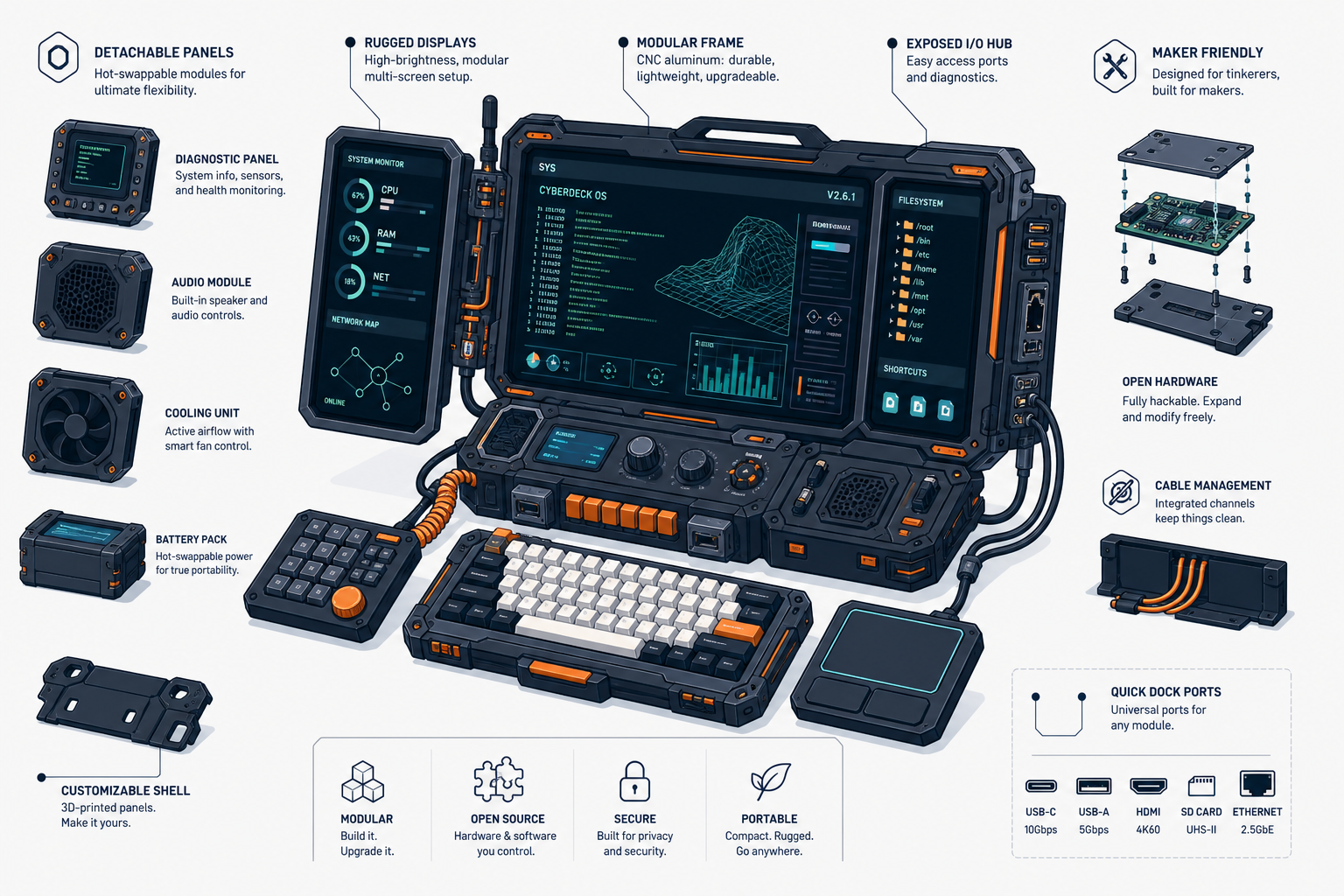
A cyberdeck is a form of custom-built computer designed for specific needs, usually in a portable, compact, and highly customizable format. For many developers, makers, and hardware enthusiasts, a cyberdeck is not just a device, but also a way of thinking: building a computer that truly matches their workflow and intended use.

What Is a Cyberdeck?

The definition of a cyberdeck and the origins of the concept

A cyberdeck is a custom computer generally built from a combination of a single-board computer, a small display, a keyboard, a battery, and other additional modules within a unique enclosure. Its form can resemble a mini laptop, a portable terminal, a tactical briefcase, or an experimental device with a futuristic style.

The term cyberdeck is heavily influenced by cyberpunk aesthetics, especially from 1980s science fiction novels such as the works of William Gibson. In cyberpunk imagination, a cyberdeck is portrayed as a portable, advanced personal computing device used to access digital networks directly. In the real world, this concept has evolved into a DIY project category that combines functionality, mobility, and strong visual character.

Today, a cyberdeck does not always have to look dark or futuristic. The core idea remains the same: a custom-built computer created for a specific purpose, often portable, modular, and highly personal.

The difference between a cyberdeck and a regular custom-built PC

The main difference lies in the design philosophy.

A regular custom-built PC generally focuses on performance, ease of upgrading, and general-purpose use such as gaming, editing, or office work. Its components also tend to follow desktop standards: ATX or micro-ATX motherboards, conventional cases, external monitors, and fixed power sources.

A cyberdeck, on the other hand, focuses more on specific functionality and integration. All components are designed to work together as a single system that can be carried around, used in the field, or optimized for particular scenarios. For example:

  • a portable Linux terminal for server administration
  • a pentesting lab device
  • a mini workstation for mobile coding
  • an IoT node for monitoring
  • an experimental computer for radio, sensors, or automation

So, while a regular custom-built PC aims for all-around performance, a cyberdeck prioritizes functional efficiency, portability, and design identity.

Main Components of a Cyberdeck

Commonly used hardware modules

The components of a cyberdeck depend heavily on its intended purpose, but the following modules are among the most commonly used:

1. Main computing unit
Typically uses:

  • Raspberry Pi
  • Orange Pi
  • LattePanda
  • Intel NUC
  • x86 mini PC
  • ESP32-based boards or microcontrollers for specific functions

If your needs are lightweight, such as terminal access, monitoring, or scripting, a Raspberry Pi is often sufficient. If you need light virtualization, fast compilation, or full desktop software, an x86 platform is more suitable.

2. Display
A cyberdeck almost always uses an integrated display. Options may include:

  • 5–10 inch HDMI LCDs
  • touchscreen displays
  • IPS panels for better viewing angles
  • e-ink for certain low-power needs

The display size will greatly affect the overall dimensions of the device.

3. Keyboard and input
The keyboard is an important element because cyberdecks are often used for typing commands, coding, or system navigation. Common choices include:

  • compact mechanical keyboards
  • mini wireless keyboards
  • custom split keyboards
  • trackballs or small touchpads
  • rotary encoders or additional macro buttons

4. Power source
For portable cyberdecks, the power system must be planned from the beginning. Common options include:

  • lithium-ion or lithium-polymer batteries
  • USB-C PD power banks
  • battery management system (BMS) modules
  • step-up/step-down converters
  • battery capacity indicators

5. Case or enclosure
The body of a cyberdeck can be made from:

  • 3D-printed parts
  • acrylic
  • aluminum
  • a small briefcase
  • modified recycled cases

This is where a cyberdeck’s character is most visible. Many makers intentionally design enclosures that are both functional and iconic.

6. Additional modules
Depending on the need, a cyberdeck can be equipped with:

  • Wi-Fi and Bluetooth
  • GPS
  • SDR (software-defined radio)
  • LoRa
  • external SSD or NVMe
  • cooling fans
  • USB hubs
  • cameras
  • environmental sensors
  • GPIO breakouts

A good cyberdeck is not the one with the most modules, but the one whose components are truly relevant to the intended use.

The role of software and operating systems in a cyberdeck

Hardware is only half the story. A cyberdeck becomes useful because the software installed on it matches its intended purpose.

Commonly used operating systems include:

  • Raspberry Pi OS
  • Ubuntu
  • Debian
  • Arch Linux
  • Kali Linux
  • Windows for certain x86-based cyberdecks

For many projects, Linux is the primary choice because it is lightweight, flexible, and easy to customize. You can build a minimal terminal interface, a lightweight desktop, or a system that boots directly into a specific application.

Examples of software needs on a cyberdeck:

  • terminal and SSH clients for remote servers
  • Docker for development environments
  • network analysis tools
  • code editors such as Neovim or VS Code
  • SDR software
  • monitoring dashboards
  • Python or Bash automation scripts

Example of basic package installation on Debian/Ubuntu:

sudo apt update
sudo apt install neovim tmux htop git curl

If you want your cyberdeck to be ready immediately for remote server access:

sudo apt install openssh-client mosh

Software determines whether a cyberdeck is merely visually appealing or truly productive for everyday use.

Why Cyberdecks Are Becoming a Custom-Built Computer Trend of the Future

The advantages of cyberdecks for developers and makers

Cyberdecks are appealing because they address increasingly specific needs. Not everyone needs a large laptop or a full desktop to work. Many developers and makers instead need a device that is:

  • quick to power on
  • lightweight to carry
  • ready for specific tasks
  • power-efficient
  • easy to modify

For developers, a cyberdeck can serve as a portable coding terminal, a debugging machine, or a tool for server access from anywhere. For makers, a cyberdeck is a project control center: connecting sensors, testing scripts, reading data, or running prototypes directly in the field.

There is also significant educational value. When building a cyberdeck, you learn about:

  • hardware integration
  • power management
  • operating systems
  • enclosure design
  • troubleshooting
  • personal computing workflows

This makes a cyberdeck more than just a custom-built device. It becomes a real learning project.

Flexibility, portability, and extensive customization

One reason cyberdecks are becoming more popular is that there are almost no rigid design limitations. You can build a device that is very simple or highly complex, depending on your budget and needs.

Some examples of design approaches:

  • an ultra-compact cyberdeck for SSH and monitoring
  • a field cyberdeck with a large battery and bright display
  • a desktop-mini cyberdeck with a full mechanical keyboard
  • an experimental cyberdeck with radio, GPS, and sensors
  • a retro-futuristic cyberdeck for personal branding projects

This flexibility is difficult for factory-made devices to match. Commercial products are usually designed for broad markets, while a cyberdeck is built for a single user with highly specific needs.

Portability is also a major advantage. With a smaller size and a self-contained power system, a cyberdeck can be used in workshops, laboratories, vehicles, server rooms, or while traveling. Its high level of customization makes each unit feel unique, both in terms of function and appearance.

A Guide to Getting Started with Building a Cyberdeck

Defining your needs and cyberdeck design

The most common mistake when starting out is buying components immediately without a clear purpose. Before assembling anything, first determine what the cyberdeck will be used for.

Some important questions:

  • Is it for coding, remote server access, monitoring, or hardware experimentation?
  • Does it need to be truly portable?
  • How much battery life is required?
  • Does it need special connectivity such as Ethernet, LoRa, or SDR?
  • Do you prioritize compact size or typing comfort?

From there, you can begin defining the design.

If the main need is a portable Linux terminal, then focus on:

  • a low-power board
  • a small, sharp display
  • a comfortable keyboard
  • sufficient battery capacity
  • a lightweight enclosure

If the requirements are heavier, such as x86 development or local data analysis, use a more powerful platform even if that means increased size and power consumption.

Create a simple sketch before buying components. It does not have to be neat; what matters is that it shows:

  • display position
  • keyboard placement
  • cable routing
  • ventilation
  • I/O ports
  • battery space

This planning will save a great deal of time during assembly.

Tips for choosing components and assembling a cyberdeck

Here are some practical tips to make your cyberdeck project more efficient:

1. Start with a simple system
Do not install too many modules right away. Build the basic version first: board, display, keyboard, and power. Once it is stable, add other features.

2. Choose compatible components that are easy to test
Make sure the display supports the output of the board you are using, the power source is stable enough, and the keyboard can be recognized by the system immediately. Poor compatibility is often the most time-consuming source of problems.

3. Pay attention to power management
This is a part that is often underestimated. Calculate the power needs of all components, especially if using batteries. Make sure there is a safe margin so the system does not shut down unexpectedly.

4. Prepare cooling
Even small boards can get hot if used continuously. Add a heatsink or a small fan if needed, especially for tightly enclosed cyberdecks.

5. Design for service access
Try to ensure that the enclosure still allows you to open certain sections without fully disassembling everything. This is important for replacing batteries, storage, or repairing cables.

6. Use reliable storage
If you are using a Raspberry Pi, consider an SSD instead of relying solely on a microSD card, especially for intensive use. This helps improve both speed and durability.

7. Test each module individually
Before installing everything into the enclosure, test each part one by one:

  • the board boots successfully
  • the display works normally
  • the keyboard functions properly
  • the battery supplies stable power
  • Wi-Fi and other ports work correctly

8. Do not ignore ergonomics
A cyberdeck that looks visually impressive is not necessarily comfortable to use. The display angle, key size, and hand position still matter if the device will be used regularly.

9. Leave room for upgrades
If possible, make space for additional modules or spare cable routes. Cyberdecks often evolve over time.

10. Document the process
Record the wiring, parts list, and software configuration. This makes troubleshooting and future upgrades much easier.

Example of a simple folder structure for storing project documentation:

cyberdeck-project/
├── docs/
├── wiring/
├── configs/
├── scripts/
└── parts-list.txt

Conclusion

A cyberdeck represents an evolution of the custom-built computer into something more personal, purposeful, and functional. It combines the DIY spirit, modern computing needs, and design freedom into a single device that can be fully tailored.

For developers and makers, a cyberdeck offers something that standard devices rarely can: full control over how a computer is built and used. If you want a work device that is more specific, portable, and unique, a cyberdeck is a project well worth trying.

Start with simple needs, choose the right components, and assemble it gradually. The best cyberdeck is not the most complicated one, but the one that fits your work best.

This article was written by artificial intelligence (AI) using the gpt-5.4 model via SumoPod AI.

This article was translated by Artificial Intelligence (AI) using gpt-5.4 via SumoPod AI.

Tidak ada komentar:

Posting Komentar

Dosen Teknik Informatika di UBP Karawang sekaligus Programmer Freelance. Menggabungkan riset akademis di bidang AI & Machine Learning dengan pengembangan solusi teknologi nyata untuk industri.

Cari Blog Ini

Diberdayakan oleh Blogger.

Arsip Blog